
Agents and digital workers
Gather approved information, prepare outputs and carry out defined actions. Decide which steps can run automatically and which require review.
Build useful tools
RUDI builds AI agents, workflow automations, and internal applications around a specific job. Work with us to define the task, test a useful version, and establish how your team will review and operate it.
Built around a specific job
Gather approved information, prepare outputs and carry out defined actions. Decide which steps can run automatically and which require review.
Connect repeatable steps such as routing a request, updating a record or preparing a scheduled report. Make exceptions visible to the person responsible.
Build a focused interface for intake, document checking, reporting or approvals. Give people a clear way to complete the task and review its results.
A working RUDI example
Our editorial digital worker gathers AI news and prepares editions for a public publication and archive. Readers can browse the results and follow the original sources.
This is one example of the software around a recurring task: collection, preparation, publication and a place for people to use the output.
See how RUDI Daily works ↗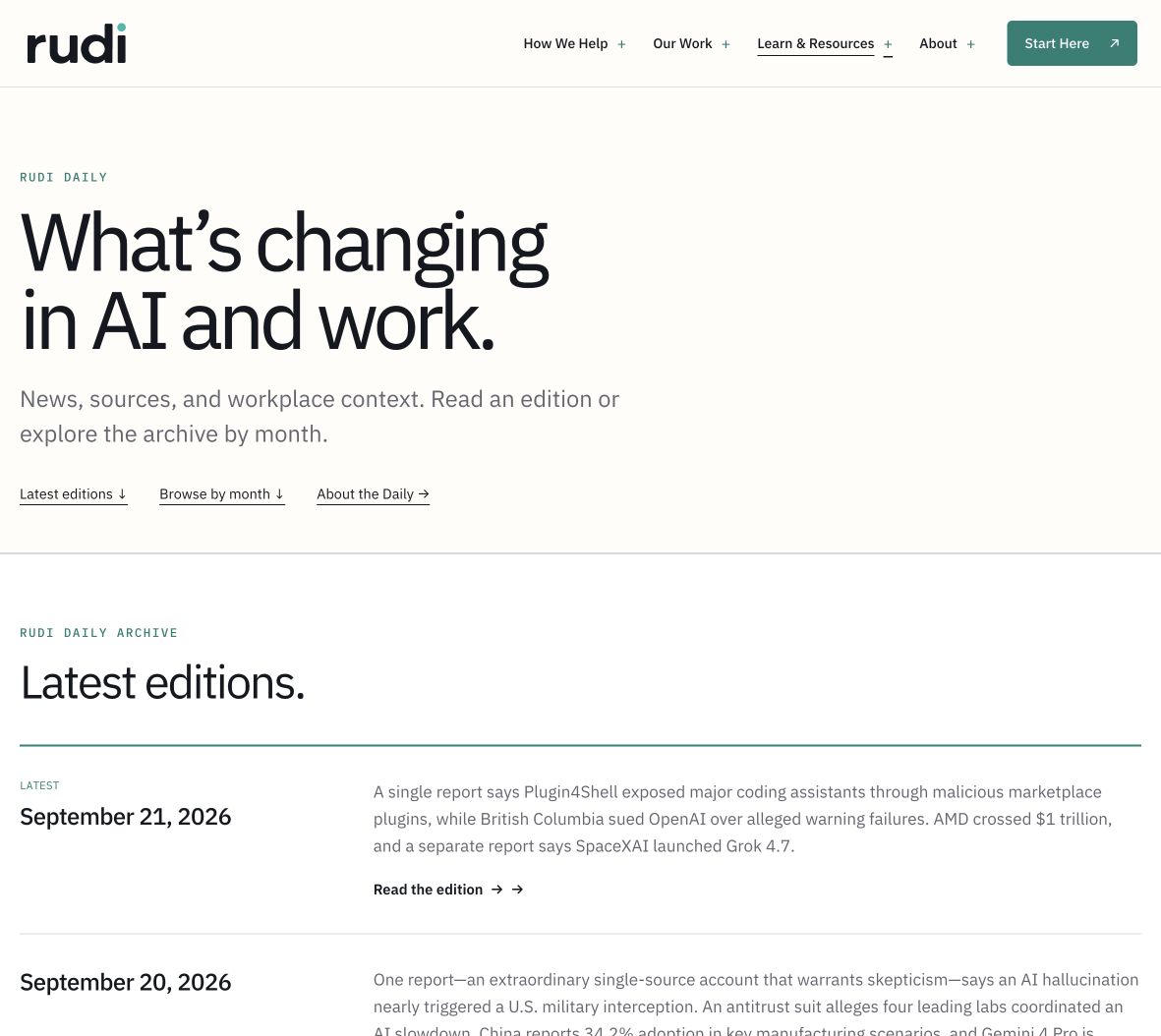
A workflow demonstrated in public
AfroTech documented a live workshop in which RUDI founder Brandon Z. Hoff used Claude Cowork to research a company, examine its website, and prepare brand guidelines and marketing materials.
The session showed how instructions, source information, connected tools, and checks fit into a repeatable workflow. It was a workshop demonstration; a production build also needs testing against the organization’s data, permissions, and operating requirements.
Read AfroTech’s account of the demonstration ↗From a task to a working tool
Agree on users, inputs, outputs, connected systems and what success means. Identify access requirements before setting the delivery plan.
Build a version your team can try on representative inputs. Review the outputs together, record what works and what fails, and use those findings to decide what needs to change.
Evaluate output quality, errors, permissions, and exceptions using RESPECT. Give the human owner a way to review, correct, and pause the work, and disclose where AI is involved.
Document how to run the tool, review its output, handle exceptions, and pause it. Name the person responsible and agree on maintenance or managed operation before handover.
Planning a build
We start with your existing tools, approved information sources, and access rules. Some tasks fit within a configured AI workspace; others need an integration or a small application. We check the platform’s capabilities and permissions before proposing a build. Explore the platforms RUDI supports.
The recurring task, its inputs and outputs, the systems involved, and the review requirements determine the work. Describe one process and what a useful result looks like. We agree on a scope, acceptance criteria, schedule, and fee before development begins.
We agree on ownership, operating instructions, and support as part of the engagement. Your team may operate the tool, or RUDI can provide ongoing managed operation. Continued monitoring, changes, and support are scoped explicitly.
Start with a department workflow engagement to map the process and test where AI can help.
Build useful tools
Describe one recurring task, the tools involved, and the output your team needs. We’ll discuss what is feasible, where human review belongs, and a useful first version.